
간행물
천문학회지 KCI 등재 SCOPUS Journal of The Korean Astronomical Society
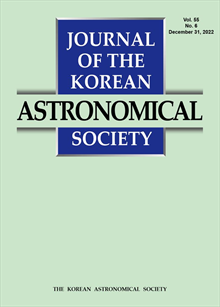
- 발행기관 한국천문학회
- 자료유형 학술지
- 간기 반년간
- ISSN 1225-4614 (Print)2288-890X (Online)
- 수록기간 1968 ~ 2026
- 주제분류 자연과학 > 천문학 자연과학 분류의 다른 간행물
- 십진분류KDC 440DDC 520
권호리스트/논문검색
제59권 제1호 (2026년 1월) 13건
1.
2026.01
구독 인증기관 무료, 개인회원 유료
We present a new fiber assignment algorithm for a robotic fiber positioner system in multi-object spectroscopy. Modern fiber positioner systems typically have overlapping patrol regions, resulting in the number of observable targets being highly dependent on the fiber assignment scheme. To maximize observable targets without fiber collisions, the algorithm proceeds in three steps. First, it assigns the maximum number of targets for a given field of view without considering any collisions between fiber positioners. Then, the fibers in collision are grouped, and the algorithm finds the optimal solution resolving the collision problem within each group. We compare the results from this new algorithm with those from a simple algorithm that assigns targets in descending order of their rank by considering collisions. As a result, we could increase the overall completeness of target assignments by 10% with this new algorithm in comparison with the case using the simple algorithm in a field with 150 fibers. Our new algorithm is designed for the All-sky SPECtroscopic survey of nearby galaxies (A-SPEC) based on the K-SPEC spectrograph system, but can also be applied to similar fiber-based systems with heavily overlapping fiber positioners.
4,000원
2.
2026.01
구독 인증기관 무료, 개인회원 유료
Jiwon Jang, Changsu Choi, Ho Seong Hwang, Haeun Chung, Hyeonguk Bahk, Dongkok Kim, Jae-Woo Kim
We present the result from a comprehensive laboratory and on-sky characterization of the commercial spectrograph system consisting of a PIXIS 1300BX charge-coupled device (CCD) camera and an IsoPlane 320A spectrograph as part of the preparation of the forthcoming all-sky spectroscopic survey of nearby galaxies (A-SPEC). In the laboratory, we have quantified readout noise, dark current, gain, and full-well capacity via bias, dark, and photon transfer curve analysis at all acquisition modes. To do that, we have developed a gradient correction technique to address row-dependent signal gradients in the image, which are caused by the shutter-less condition of our CCD camera test setup. The technique successfully reproduces the values in the manufacturer specifications. We also have measured quantum efficiency exceeding 80% from 400–800 nm and ≳ 90% between 450–750 nm, with sub-second persistence decay, making it ideal for rapid, multi-object spectroscopy. Using a set of diffraction gratings (150, 300, and 600 grmm−1), we have evaluated the spatial separability of multiple spectra and spectral resolution. We have conducted a test observation with this spectrograph system at the Seoul National University Astronomical Observatory (SAO) 1 m telescope and successfully demonstrated its capability of multi-object spectroscopy with moderate resolution of R ≈ 600–2600. We release all Python codes for the test and recipes to facilitate further instrument evaluations.
5,700원
3.
2026.01
구독 인증기관 무료, 개인회원 유료
Jong-In Park, Hyunmi Song, Ho Seong Hwang
We determine the galaxy luminosity function of cluster galaxies in the nearby galaxy cluster Abell 2199 (A2199), focusing on the faint-end slope down toMr ∼ −14.5. To achieve this, we augment the existing dataset by adding redshift data from our deep MMT/Hectospec survey and from the Dark Energy Spectroscopic Instrument (DESI), significantly improving the spectroscopic completeness down to rpetro,0 = 20.8 within the central 30′ region. The resulting luminosity function is well described by a Schechter function with a characteristic magnitudeM∗ = −21.30±0.27 and a faint-end slope α = −1.23±0.05. This faint-end slope is consistent with those measured in the nearby Coma and Virgo clusters and in a cluster from the TNG50 cosmological simulation, and is slightly shallower than that of field galaxies. These findings indicate that the previously claimed steep faint-end upturn (with α ∼ −2) in nearby galaxy clusters is not supported. Instead, they indicate that environmental processes in dense cluster cores do not seem to trigger the formation or survival of low-mass galaxies, thereby preventing a steep faint-end upturn in the luminosity function.
4,300원
4.
2026.01
구독 인증기관 무료, 개인회원 유료
Hyo-Geun Ji, Sung-Jin Oh, Jeong-In Yeo, Heon-Young Chang
In this study, we explore the solar differential rotation using recurrent sunspots observed by space-borne instruments from August 1996 to June 2025. To avoid systematic errors, the differential rotation profiles are calculated taking into account both Earth’s elliptical orbit and the inclination of the solar rotation axis to the ecliptic. We have found that the equatorial rotation rate first increases and then decreases in Solar Cycles 23, 24, and 25, which can be interpreted as torsional oscillations with a period of approximately 11 years. When comparing the angular rotation rates at the solar maximum and minimum, the latitudinal gradient of rotations at solar minima exhibits significant cycle-to-cycle variation. During the descending phase, the latitudinal gradient of rotations changes significantly between solar cycles. The latitudinal gradient of rotations in the northern hemisphere is comparable across solar cycles, whereas that in the southern hemisphere displays significant modulations across solar cycles. In terms of the Zürich sunspot classification system, the equatorial rotation rate is higher and the differential rotation is stronger for J-type groups than for H-type groups. It is also attempted to investigate the dependence on the order of successive passages, revealing that although the equatorial rotation rates for the first and second passages are similar, the differential rotation for the second passage appears significant. This is indicative of less rigid rotation during the second passage. To conclude, we point out that the Sun appears to rotate more differentially in the case that the solar magnetic activity is relatively weaker, when comparing cases of weak and strong solar activity.
4,300원
5.
2026.01
구독 인증기관 무료, 개인회원 유료
Low-surface-brightness (LSB) structures play a crucial role in understanding galaxy evolution by providing significant insights into galaxy interactions, the histories of mass assembly, and the distribution of dark matter. Nevertheless, their inherently faint nature, coupled with observational difficulties such as stray light interference and variations in the sky background, has significantly impeded comprehensive studies of LSB features. The KASI Deep Rolling Imaging Fast Telescope (K-DRIFT) project aims to address these observational challenges by developing off-axis freeform three-mirror telescopes and observational strategies specifically designed for LSB imaging surveys. The first generation of K-DRIFT (G1) has been successfully completed, and the forthcoming survey, scheduled to commence shortly, is expected to yield novel insights into the LSB universe. This paper outlines the scientific motivations of the project, discusses the technical challenges encountered, highlights the innovative solutions devised, and describes the future trajectory of the K-DRIFT.
4,600원
6.
2026.01
구독 인증기관 무료, 개인회원 유료
The KASI Deep Rolling Imaging Fast Telescope (K-DRIFT) is a pioneering instrument designed to explore low-surface-brightness (LSB) phenomena. This white paper presents a compelling set of science cases that showcase K-DRIFT’s unique capabilities in unraveling the mysteries of intracluster light (ICL) and other LSB components within galaxy clusters. Exploring the origin of ICL in galaxy clusters and comparing the spatial distributions of ICL and dark matter will offer new insights into galaxy cluster dynamics. Moreover, investigating LSB objects in galaxy clusters, such as LSB structures in the brightest cluster galaxies, ultra-diffuse galaxies, and tidal features, will enhance our understanding of galaxy evolution within the cluster environment. We present our strategies for addressing scientific queries, encompassing LSB observation and analysis techniques, specialized simulations, and machine-learning approaches. Additionally, we examine the potential synergies between K-DRIFT and other ongoing and forthcoming multi-wavelength surveys. This white paper advocates for the recognition and support of K-DRIFT as a dedicated tool for advancing our understanding of the universe’s subtlest phenomena.
5,400원
7.
2026.01
구독 인증기관 무료, 개인회원 유료
Kwang-il Seon, Jaehyun Lee, Jongwan Ko, Woowon Byun, Jaewon Yoo, Kyungwon Chun, Sang-Hyun Chun, Sungryong Hong, Jae-Woo Kim, Hong Soo Park, Jihye Shin
In this paper, we review the extended halo material and the circumgalactic medium (CGM), including both dust and gas, and discuss promising science cases that could be realized using the KASI Deep Rolling Imaging Fast Telescope (K-DRIFT). Scattered starlight from cirrus clouds in our Galaxy poses one of the major challenges to studying the low surface brightness features of extragalactic sources. Therefore, it is essential to investigate how to discriminate extragalactic sources from cirrus cloud features. At the same time, interstellar dust clouds themselves are fundamental to understanding dust properties and the interstellar radiation field, both of which are essential for studies of chemical evolution and star formation in our Galaxy. Measuring the reddening of background sources, such as quasars, with K-DRIFT, which benefits from its broad field of view and accurate background subtraction, allows for the effective detection of extended dust in galactic halos, the CGM, and intracluster space. Observations of the Hα emission lines can be used to identify signatures of star formation activity within galaxies, as well as the environmental effects acting on them. Galactic winds driven by active galactic nuclei and starbursts can be traced through Hα emission. Strong ram pressure stripping effectively removes the interstellar medium (ISM) from galaxies. The stripped ISM becomes ionized or dissociated through mixing with the hot intracluster medium (ICM), forming Hα tails. The surface brightness of these Hα tails correlates not only with the presence of star formation in the tails but also the mixing stage of the stripped ISM and ICM. The Hα survey with K-DRIFT will enable the investigation of the evolutionary stages of ram pressure stripped galaxies in cluster environments, as well as the multiphase gas reservoir around galaxies and in the CGM.
4,800원
8.
2026.01
구독 인증기관 무료, 개인회원 유료
Low-surface-brightness (LSB) structures serve as evidence of the intricate mass assembly of galaxies, and dedicated studies of these structures promise profound insights into the evolutionary history of galaxies. Furthermore, delving into the properties of star formation (SF) in the LSB regime can broaden our understanding of SF activity in regions characterized by low surface gas density, thereby shedding light on fundamental cosmic processes. However, systematic uncertainties may hamper the exploration of the LSB universe by limiting detectable SB levels. Indeed, despite dedicated advancements in telescope and observing techniques over decades, achieving ultra-deep photometric depths in optical wavelengths remains a formidable challenge. To overcome this challenge and explore the LSB universe that we have yet to see, we have been developing a novel telescope called K-DRIFT. This paper outlines the telescope’s specifications and describes various LSB features we aim for, explicitly focusing on nearby individual galaxies. To further advance the capabilities of the K-DRIFT survey, focused on LSB detection, we present several feasible research topics that utilize other survey data together and discuss the role of LSB observation in understanding the evolution of galaxies.
6,000원
9.
2026.01
구독 인증기관 무료, 개인회원 유료
Low-surface-brightness (LSB) structures provide critical insights into the hierarchical formation of galaxies and galaxy clusters. The KASI Deep Rolling Imaging Fast Telescope (K-DRIFT) is designed to detect such diffuse features through deep, wide-field optical imaging with a surface brightness reaching ∼30 mag arcsec−2. To interpret the observational data expected from KDRIFT, we have developed the Galaxy Replacement Technique (GRT), an N-body simulation framework optimized for tracing the gravitational evolution of stellar components. The GRT works by inserting high-resolution galaxy models, including a dark matter (DM) halo and stellar disk, in place of multiple low-resolution DM halos in the base N-body cosmological simulation. It allows us to achieve very high mass (mstar = 5.4×10⁴M⊙ h−1) and spatial resolution (10 pc h−1) with shorter computation time compared to full hydrodynamic cosmological simulations. Therefore, this technique is particularly well-suited for studying LSB structures, with a surface brightness reaching ∼31 mag arcsec−2. In this paper, we present the motivation and methodology of the GRT, summarize key results from previous studies, and highlight its synergy with K-DRIFT observations. We further discuss planned science cases using the GRT, aiming to build a theoretical basis for interpreting LSB features in various environments.
4,600원
10.
2026.01
구독 인증기관 무료, 개인회원 유료
Sunho Jin, Jooyeon Geem, Masateru Ishiguro, Woojin Park, Heeyoung Oh, Chan Park, Seungwon Choi, Yoonsoo P. Bach, Hyeonwoo Ju, Jinguk Seo, Bumhoo Lim, Myungshin Im
We present SQUIDPOL, a low-cost, multi-channel optical imaging polarimeter that performs simultaneous linear polarization measurements using a rotating half-wave plate, a non-polarizing beam splitter, and four wire-grid filters. We show that the multilayer dielectric coating of the off-the-shelf non-polarizing beam splitter introduces different phase delays to the s- and p-polarized components, which introduces polarization-dependent systematics that can bias polarimetric measurements if left uncorrected. We quantify this effect for both transmitted and reflected beams and incorporate a correction scheme into the data-analysis pipeline. On-sky validation demonstrates stable and reproducible performance, achieving a polarization accuracy of σP ∼ 0.15% for bright polarimetric standard stars (V ∼ 2–3 mag). Mounted on the 60-cm Ritchey-Chrétien telescope (focal length of 4200mm, f/7) at the Pyeonchang Observatory of Seoul National University, SQUIDPOL provides an effective common field of view of 13.5′ × 8.2′ with a pixel scale of 0.45′′ pixel−1 and supports standard B, V , RC, and IC filters.
4,500원
11.
2026.01
구독 인증기관 무료, 개인회원 유료
Jimin Hong, Jungjoon Seough, Kyungguk Min
Coulomb collisions are believed to be a fundamental process governing the thermodynamic equilibrium of solar wind plasmas, yet their role within the Alfvénic slow solar wind remains poorly understood. In this study, we carry out a statistical analysis of proton core parameters measured by the Helios spacecraft to examine how its temperature anisotropy (T⊥/T∥) varies with collisional age for three types of solar wind, namely, fast wind, Alfvénic slow wind, and non-Alfvénic slow wind. Here, T⊥ and T∥ denote the proton temperatures perpendicular and parallel to the ambient magnetic field. Consistent with previous findings, we confirm that Coulomb collisions play a negligible role in the fast wind but strongly regulate the thermodynamics of non-Alfvénic slow wind. Remarkably, however, the Alfvénic slow wind displays two distinct regimes: a weakly collisional regime characterized by significant temperature anisotropy, T⊥/T∥ > 1, and a collisionally regulated regime characterized by T⊥/T∥ ≈ 1. In addition, a close examination of the radial evolution of several well-defined Alfvénic slow wind streams indicates that their thermodynamic behavior is strongly governed by several key plasma parameters, notably the solar wind speed. This in turn implies that the origin of the streams—either the cores of coronal holes or their over-expanded edges—determines the dominant processes governing the dynamics and thermodynamics of the Alfvénic slow wind.
4,500원
12.
2026.01
구독 인증기관 무료, 개인회원 유료
Jubee Sohn, Ian P. Dell’Antonio, Margaret J. Geller
We describe spectroscopic tomographic weak lensing measurements (spectrotomography) for two rich clusters of galaxies, A1767 and A2065, based on extensive spectroscopy and Subaru/Hyper Suprime-Cam (HSC) imaging. These detections represent the first use of spectrotomography based on archival Subaru/HSC imaging. The measurements depend only on galaxies with spectroscopic redshifts reported here. The approach cleanly separates cluster members from the background and suppresses systematics that may be introduced by the use of photometric background redshifts. We detect the tomographic shear signals at 3.1σ (A1767) and 3.5σ (A2065). The shear signal amplitudes are consistent with the cluster dynamical (caustic) masses, and they scale appropriately with source redshift. However, comparison with the first spectrophotometric detection of A2029 based on DECam imaging reveals some subtle potential systematic issues in deriving the shear signal for the relatively bright background galaxies used in the analysis. These issues may be important for understanding more extensive future applications of spectrotomography based on further Subaru imaging, as well as Euclid and LSST data. The total of three spectrophotometric detections (A1767, A2029, and A2065) sets the stage for broader application of the technique for unbiased cluster weak lensing mass determinations and potentially for a geometric cosmological test that is independent of other methods.
4,500원
13.
2026.01
구독 인증기관 무료, 개인회원 유료
Bumhoo Lim, Seungwon Choi, Yoonsoo P. Bach, Masateru Ishiguro, Sunho Jin, Carey M. Lisse, Max Mahlke, Jooyeon Geem, Jinguk Seo, Sihu Ahn, Hangbin Jo
We present the Solar system Objects Light curve Observatory (SOLO), a wide-field, high-cadence optical survey system designed to obtain absolutely calibrated asteroid light curves, converted to the Gaia G-band photometric system, in support of the SPHEREx Solar System Object Catalog (SSOC). SOLO was installed at the Sierra Remote Observatories (SRO) in California, USA, in July 2025 and is optimized for continuous, multi-night monitoring of asteroid brightness variations. We describe the system configuration, remote operation, and data reduction pipeline, and evaluate its optical and photometric performance using commissioning data. SOLO achieves stable photometric calibration across the 11.6 deg2 field of view and reaches a 10-σ limiting magnitude of G ∼ 17.5 for a 180 sec exposure. Sample asteroid light curves obtained over multiple nights demonstrate consistent absolute photometry at the same rotational phase, validating the estimated performance. Finally, we outline the planned operational use of SOLO in connection with NASA’s SPHEREx mission. Full science operations of SOLO are scheduled to begin in January 2026. Using these data, we aim to obtain on the order of 103 absolutely calibrated asteroid light curves per year in the Gaia G band, which will be used to support the construction and scientific utilization of the SPHEREx SSOC.
4,200원
