
간행물
산업식품공학 KCI 등재 Food Engineering Progress
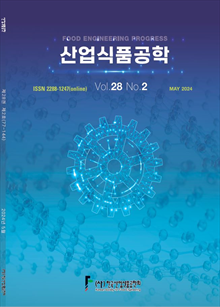
- 발행기관 한국산업식품공학회
- 자료유형 학술지
- 간기 부정기
- ISSN 1226-4768 (Print)2288-1247 (Online)
- 수록기간 1997 ~ 2026
- 주제분류 농수해양 > 식품과학 농수해양 분류의 다른 간행물
- 십진분류KDC 574DDC 664
권호리스트/논문검색
제29권 제4호 (2025년 11월) 13건
1.
2025.11
구독 인증기관 무료, 개인회원 유료
Min Joo Kang, Sulhee Lee, Min-Gyu Lee, Huijin Jeong, Dae-Kyung Kang, Hyun Dong Paik, Young-Seo Park
The lactic acid bacteria, Lactiplantibacillus plantarum KU15149 and Levilactobacillus brevis KU15176 were verified through phenotypic and genotypic analyses. Safety evaluation was conducted using multiple assays, including minimum inhibitory concentration assay for nine antibiotics, hemolytic activity, mucin degradation, gelatin liquefaction, urease activity, indole production, β-glucuronidase activity, bile salt deconjugation, cell cytotoxicity, D-/L-lactic acid production, and biogenic amine formation. Genotypically L. plantarum KU15149 and L. brevis KU15176 lacked all virulence and antibiotic resistance genes investigated. Consistent with these results, phenotypic assays showed that both strains were susceptible according to EFSA cut-off values and tested negative for hemolysis, mucin degradation, gelatin liquefaction, urease activity, indole production, β-glucuronidase activity, and bile salt deconjugation. Furthermore, neither strain showed cytotoxicity toward Caco-2 cells at a multiplicity of infection of 250. Production of D-lactic acid and biogenic amines was negligible in both bacteria. Overall, L. plantarum KU15149 and L. brevis KU15176 demonstrated safety and beneficial characteristics and therefore could serve as probiotic strains.
4,300원
2.
2025.11
구독 인증기관 무료, 개인회원 유료
Mi Hwa Park, Sondor Ganbat, Ji Yeong Park, Dariimaa Ganbat, Yong-Jik Lee, Sang-Jae Lee
Lactic acid bacteria (LAB) and qualified presumption of safety (QPS)-designated Bacillus strains are widely applied to enhance the nutritional and functional properties of natural products. Green garlic (Allium sativum L.), a common Korean vegetable and recognized functional food, is valued for its antioxidant and immune-enhancing activities. In this study, we investigated the functional properties of green garlic fermented with LAB and QPS-designated Bacillus strains. A total of 450 strains were isolated from marine environments, livestock sources, and diverse agricultural and fishery products, including fermented derivatives, of which 191 originated from agricultural products. Enzyme assays identified 89 strains with strong protease and amylase activities. After excluding taxonomic duplicates, we obtained seven QPS-designated Bacillus strains and four LAB strains characterized by robust growth in media containing green garlic. Fermentation using Sacheon green garlic powder was conducted for 4 days, and compared with the control, we found that the antioxidant activity of green garlic fermented with Latilactobacillus curvatus GH-11-11 and Bacillus amyloliquefaciens JY-48-5 increased by 144.0% and 145.8%, respectively. In addition, relative to a non-fermented extract, a 2-day fermentation with JY-48-5 enhanced α-glucosidase inhibitory activity by over 189.4%. These findings indicate that cultures of selected LAB and QPS-designated Bacillus strains could serve as promising starters for enhancing the bioactive properties of foods, and also emphasize the importance of regional microbial resources.
4,000원
3.
2025.11
구독 인증기관 무료, 개인회원 유료
Dong Hoon Kim, Yohan Song, Gunhyung Park, Huin Lee, Hee Chung, Hyo Jin Kim, Donghwa Chung
In this study, we investigated the effects of aging treatment on the physicochemical, mechanical, and barrier properties of edible composite films prepared from shellac (Sh) and cellulose nanofiber (CNF) with different blending ratios. Sh–CNF films (0%, 20%, and 50% CNF) were fabricated and subjected to aging for 7 days at 40°C and 53% relative humidity. Film thickness was found to decline with both CNF incorporation and aging, whereas there were corresponding increases in opacity, particularly in Sh-rich films. In addition, the moisture content and water solubility of films declined at higher CNF ratios, and aging contributed to further reductions in moisture content, although had no significant effects on water solubility. Color analysis revealed that aging promoted the yellowing of pure Sh films, whereas the addition of CNF mitigated these changes. The findings of mechanical analysis revealed that CNF enhanced tensile strength, yield stress, Young’s modulus, and work of break, although reduced elongation at break. Aging contributed to further enhancements of strength and stiffness, along with a reduction in flexibility, although the magnitude of change diminished at higher CNF contents. Furthermore, the findings of gas barrier analysis indicated that CNF was associated with reductions in oxygen permeability, although promoted increases in water vapor permeability, with aging having the opposite effects. Collectively, these findings revealed that the functional properties of Sh–CNF films can be tailored via controlled aging and blending, thereby highlighting the potential utility of these films as edible packaging materials.
4,000원
4.
2025.11
구독 인증기관 무료, 개인회원 유료
Sondor Ganbat, Mi Hwa Park, Joo Young Yang, Dariimaa Ganbat, Yong-Jik Lee, Sang-Jae Lee
A total of 128 halophilic and marine-associated bacterial strains were isolated from environmental marine samples and fermented seafood products collected in the Sacheon region of South Korea. The aim was to secure region-specific microbial resources and evaluate their potential for industrial use. The isolates belonged to 4 phyla, 15 families, 30 genera, and 61 species. The phylum Bacillota, particularly the family Bacillaceae, was the major taxonomic group (62.5%), comprising 14 genera and 36 species, such as Alkalihalobacillus, Bacillus, Caldibacillus, Cytobacillus, Fictibacillus, Halobacillus, Lysinibacillus, Metabacillus, Neobacillus, Oceanobacillus, Priestia, Rossellomorea, Rummeliibacillus, and Ureibacillus. Members of the phylum Pseudomonadota, primarily the family Alteromonadaceae, accounted for 4.7% of the isolates and included the genera Marinobacter and Microbulbifer. All isolates identified as members of the phylum Pseudomonadota were strong auxin producers or showed high extracellular enzyme activities. Functional characterization showed that 86 strains (67.2%) exhibited hydrolytic activity for at least one enzyme (protease, amylase, or lipase), and 32 strains (25%) produced auxin. The functions of the microbial resources in the Sacheon region are highly diverse. Collectively, the isolated strains show potential for application in managing marine environments, bioprocessing, and the fermented seafood industry, underscoring their value as genetic resources for future biotechnological use in South Korea.
4,000원
5.
2025.11
구독 인증기관 무료, 개인회원 유료
김지연, 심기현
This study aimed to enhance the value of traditional Korean sweet Dasik by incorporating citrus mandarin powder rich in functional components. Jinmal Dasik was prepared using citrus mandarin powder at concentrations of 0%, 8%, 16%, 24%, and 32%. Quality characteristics, sensory properties, and antioxidant activities of the samples were evaluated. As the citrus mandarin powder concentration increased, moisture and sugar content increased, while pH decreased. Color measurements revealed decreased lightness and increased redness and yellowness. Mechanical texture parameters showed no significant differences among the groups. In sensory evaluation, the 24% sample received the highest scores for appearance, taste, texture, and overall acceptability, while the 24% and 32% samples achieved the highest aroma scores. Quantitative descriptive analysis indicated that higher powder levels increased yellowness, citrus aroma, sweetness, sourness, bitterness, astringency, and moistness, though no significant differences were observed in terms of hardness and chewiness. Principal component analysis supported these trends. The antioxidant activity of Jinmal Dasik, including total phenol and flavonoid contents, DPPH radical scavenging activity, and reducing power, increased with higher levels of citrus mandarin powder. Overall, the addition of 24% citrus mandarin powder was optimal for improving the sensory acceptability, antioxidant activity, and quality attributes of Jinmal Dasik.
4,000원
6.
2025.11
구독 인증기관 무료, 개인회원 유료
황수정, 최현욱
In this study, freeze-dried red beet powder was characterized for its physicochemical properties and functional components and subsequently incorporated into rice cookies at levels of 0%, 2%, 4%, 6%, and 8% to assess its effects on quality characteristics and antioxidant activity. As the level of red beet powder increased, moisture content decreased, whereas both the diameter and thickness of the rice cookies increased, resulting in a reduced spread ratio. In terms of color parameters, lightness and yellowness decreased, whereas redness significantly increased with increasing red beet powder content, indicating a distinct visual change in the cookies. Antioxidant activity increased proportionally with red beet powder levels. These findings demonstrate that incorporating red beet powder effectively enhances the antioxidant activity and functional properties of rice cookies.
4,000원
7.
2025.11
구독 인증기관 무료, 개인회원 유료
김형섭, 김성후, 김영은, 손석호, 박성훈
This study evaluated the applicability of ‘Baromi2’ (B2) rice flour as a functional ingredient in lean bread by replacing wheat flour at levels of 10%, 20%, and 30%. Bread was produced under standardized baking conditions, and its quality characteristics were assessed through physicochemical analyses (including specific volume, texture, and color). The internal crumb structure was also examined to assess gluten network integrity. As the substitution level increased, finished product volume decreased and crumb hardness significantly increased, indicating weakening of the gluten network. Internal structure analysis revealed that higher substitution levels and reduced pore evenness. Among the samples, the 10% substitution level produced bread with the most balanced texture and crumb structure. These results suggest that ‘B2’ rice flour can be used to partially replace wheat flour in lean bread to enhance nutritional diversity and maintain product quality.
4,000원
8.
2025.11
구독 인증기관 무료, 개인회원 유료
오해원, 이승환
Protein is an essential nutrient for sustaining human life; however, securing sufficient protein through the traditional livestock industry is predicted to become difficult in the future. Microalgae have high potential as alternative protein sources owing to their efficiency in resource utilization and sustainability. The major challenge in the high value-added use of microalgae is the effective recovery of their small cells. Electro-coagulation technology is a harvesting method that has little direct or indirect effect on microalgae and causes no environmental pollution. To optimize the harvest yield of Scenedesmus obliquus, this study examined how stirring, stirring speed, initial pH, electrode material, current density, current intensity, electrode spacing, and electrode placement affected microalgae recovery and determined optimal harvest conditions. The optimal culture conditions were a stirring speed of 100 rpm, initial pH of 5.0, using aluminum electrodes, current density of 20 A/m2, current intensity of 0.3 A, electrode spacing of 1 cm, and electrode placement of (–) electrode, (+) electrode, (–) electrode. These findings can be used to increase the harvest yield of microalgae as an alternative protein resource.
4,000원
9.
2025.11
구독 인증기관 무료, 개인회원 유료
김성후, 오혜원, 조은희, 송성봉, 박성훈
This study evaluated the effects of mixed fermentation using the wild yeast Kluyveromyces marxianus NIYC1 (KM) from a medicinal starter culture, indigenous baking yeast Saccharomyces cerevisiae SPC-SNU 70-1, and lactic acid bacteria (LAB) on the physicochemical quality and aroma compounds of bread. Bread was prepared using the sponge-dough method, and proximate composition, specific volume, texture, gas production, pH, total titratable acidity (TTA), and volatile organic compounds (VOCs) were analyzed. The results showed that KM exhibited a higher specific volume and superior gas production during early fermentation compared with the control, improving dough expansion and final volume. LAB demonstrated stable fermentation and a lower increase in hardness during storage, effectively regulating acidity and enhancing flavor complexity. VOC analysis revealed that LAB increased alcohol content, whereas KM promoted fatty and organic acids. Both strains suppressed the production of off-flavor compounds. These findings indicate that mixed fermentation with KM and LAB offers superior fermentation performance, texture, flavor complexity, and storage stability compared to commercial yeast fermentation. This study highlights the industrial potential of underutilized microbial resources and provides foundational data for the development of functional and value-added bakery products.
4,000원
10.
2025.11
구독 인증기관 무료, 개인회원 유료
정하연, 심도현, 한나련, 이경미, 신정규
In this study, we aimed to compare the quality characteristics of madeleines prepared by substituting wheat flour with stabilized rice bran (SRB) at levels of 0–40%, and evaluated physicochemical properties and consumer acceptability to investigate sensory characteristics. Volume and baking loss significantly increased, whereas the moisture content significantly decreased with increasing SRB substitution levels (p<0.05). Concerning color, the L* value significantly decreased, whereas the a* and b* values significantly increased with an increasing SRB content (p<0.05). In the texture profile analysis, hardness significantly decreased with higher SRB levels. Moreover, both gumminess and chewiness displayed significant reduction in proportion to the SRB content. In the consumer acceptability test, the control group exhibited the highest score for appearance (7.91±1.25), while the appearance scores of SRBadded samples decreased with an increasing SRB content, suggesting that darker colors negatively influenced consumer preference. However, the SRB 30% group yielded the highest scores in grain flavor and overall acceptability (6.00±2.16 and 6.53±1.68, respectively). Based on the combined results of quality characteristics and consumer evaluation, we determined 30% SRB substitution the most suitable level for madeleine formulation.
4,000원
11.
2025.11
구독 인증기관 무료, 개인회원 유료
정재훈, 조영상
Raw milk contains various microorganisms, necessitating effective sterilization for food safety. As traditional methods of using impellers and magnetic bars in round-bottom flasks remain inefficient and time-consuming, we developed and validated a lowtemperature pasteurization technique using a Taylor vortex mixer. In this study, we analyzed raw milk pasteurization efficacy and rancidity and compared the results with those obtained using different types of mixing systems, such as Taylor vortex and conventional mixers. During the experiments, the sterilization temperature and time were varied to measure milk sample acidity via acid-base titration for the quantitative assessment of rancidity and sterilization effects. We assessed microbial survival through specific culture media. The Taylor vortex system demonstrated superior sterilization efficiency with minimal rancidity, which was attributed to its high thermal and mass transfer efficiencies. In summary, we established the Taylor vortex mixer as an effective and quality-preserving alternative for raw milk pasteurization, highlighting its potential use in the food industry.
4,000원
12.
2025.11
구독 인증기관 무료, 개인회원 유료
박예지, 고민정
Tarragon (Artemisia dracunculus L.) is a medicinal herb traditionally used to treat digestive disorders and stomach ulcers. In this study, the extraction characteristics of the major bioactive compounds of tarragon, estragole, eugenol, and herniarin, were determined using subcritical-water extraction (SWE) and ultrasound-assisted extraction (UAE). Their efficiencies, compared to conventional solvent extraction, were evaluated. For SWE, the highest yields were obtained for estragole (0.66±0.04 mg/g) at 200°C for 5 min, eugenol (0.11±0.00 mg/g) at 200°C for 15 min, and herniarin (3.35±0.09 mg/g) at 190°C for 5 min. For UAE, only herniarin (1.49±0.07 mg/g) was detected, with a maximum yield of <350 W for 10 min. For conventional solvent extraction, eugenol was not detected, for 100% methanol (45°C, 120 min), the highest yield for estragole was 0.37±0.05 mg/g, and for hot water extraction (90°C, 120 min), the yield for herniarin was 1.59±0.04 mg/g. Among the tested methods, SWE had the highest overall efficiency without the use of organic solvents, highlighting its potential as a rapid and eco-friendly technique for effective extraction of bioactive compounds from tarragon.
4,000원
13.
2025.11
구독 인증기관 무료, 개인회원 유료
이혜윤, 최정연, 김주상, 천지연
In this study, the aim was to establish a pre-treatment process to utilize citrus pomace (CP) as a high-value-added material. Frozen CP was thawed under various conditions, including at room temperature, using ultrasound, and immersion at 25℃ and 70℃, and samples from each thawing group were assigned to a non-washed (NW) or a washed (W) group. The samples in the W-CP groups were drained, and all samples were powdered after hot air drying. The samples in the NW-CP groups had a two-fold higher drying yield of CP powder, a significantly lower pH (4.20–4.26), and a higher soluble solids content (1.1–1.3°Brix) than the samples in the W-CP groups. Interestingly, the samples in the W-CP groups had significantly higher swelling capacity (8.18–8.53 mL/g), water absorption index (7.61–7.85 g/g), water holding capacity (8.92–10.30 g/g), and oil holding capacity (2.09–2.30 g/g) than samples in the NW-CP groups (p<0.05). Conversely, the thawing method only significantly affected the thawing rate of the CP, but it did not significantly affect the properties of the CP powder. The results of this study provide basic data for the industrialization and resource utilization of CP, and they suggest that various pre-treatment processes can influence CP standardization.
4,200원
